What was the question?
Does an ultra-processed diet cause people to consume more energy than an unprocessed diet when they are free to eat as much or as little as they wish?
Published with a correction
Ultra-Processed Diets Cause Excess Calorie Intake and Weight Gain: An Inpatient Randomized Controlled Trial of Ad Libitum Food Intake
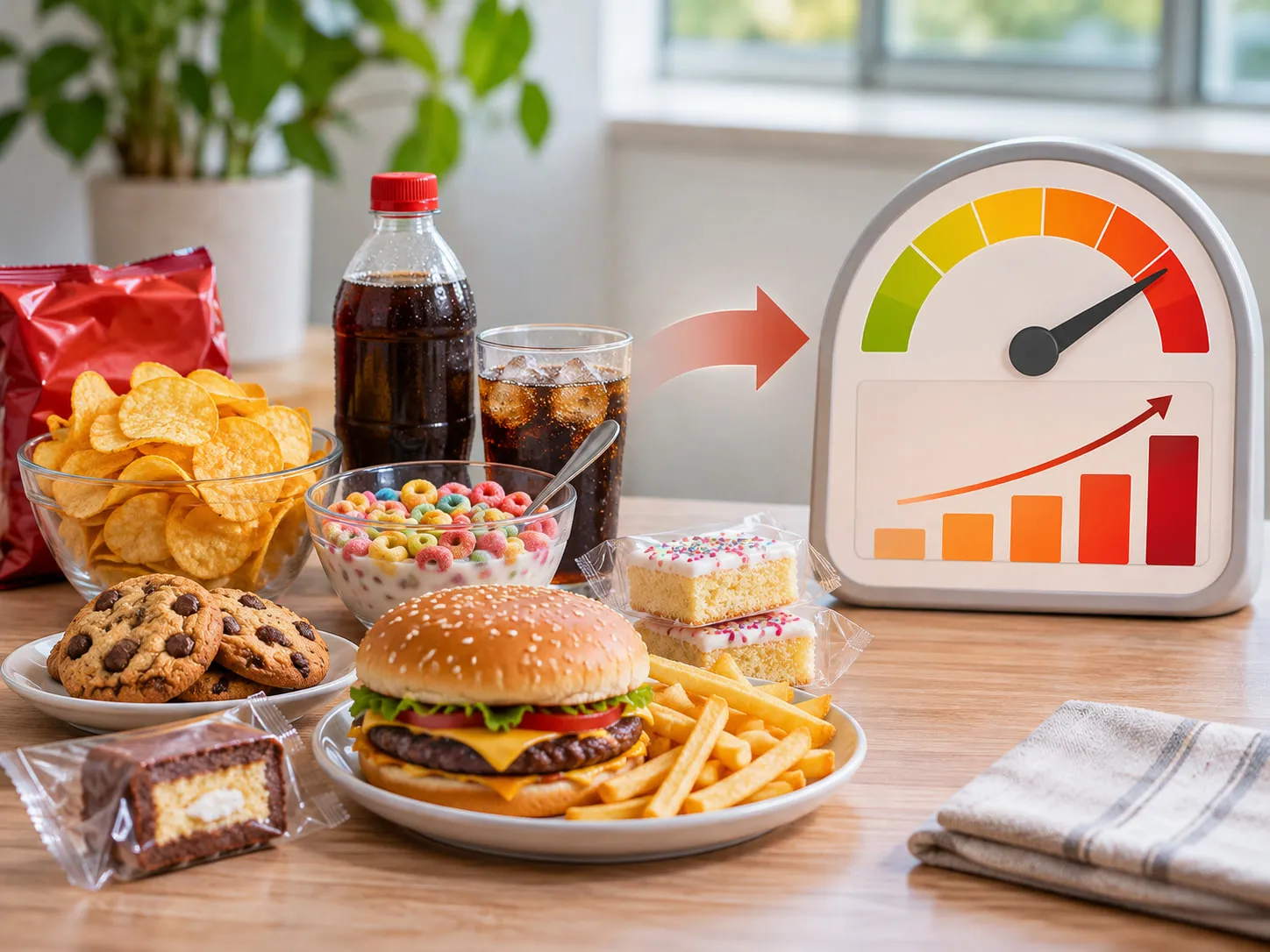
In a randomized crossover feeding trial of 20 adults, energy intake was 508 ± 106 kcal/day higher on an ultra-processed diet than on an unprocessed diet over two 14-day periods. The ±106 is a standard error, not a 95% confidence interval.
Ultra-Processed Diets Cause Excess Calorie Intake and Weight Gain: An Inpatient Randomized Controlled Trial of Ad Libitum Food Intake
Does an ultra-processed diet cause people to consume more energy than an unprocessed diet when they are free to eat as much or as little as they wish?
Twenty adults lived at the NIH Clinical Center for four weeks. Each participant received an ultra-processed diet and an unprocessed diet for 14 days each in randomized order. The presented menus were designed to be matched on several nutritional characteristics. Actual food consumption was measured while participants ate freely.
Average daily energy intake was 508 kcal higher on the ultra-processed diet (standard error 106 kcal; p = 0.0001). Participants gained approximately 0.9 kg during that phase and lost approximately 0.9 kg during the unprocessed phase. These are short-term average observations, not predictions for every individual.
These findings concern adults monitored in a research inpatient unit. The eligibility criteria included ages 18–50 years. The same effect size cannot be assumed for children, people with chronic illnesses, or free-living populations.
The study suggests that food processing and related characteristics may influence how much people eat, even when the offered menus are matched on several nutritional variables. Choosing more minimally processed foods can be one useful consideration within a practical and balanced dietary pattern.
This trial does not establish that all packaged foods are harmful, nor that an ultra-processed diet causes cancer, diabetes, or cardiovascular events. It was not designed to identify the single causal food property, or to show whether short-term weight effects persist long term.
For researchers and health professionals. Figures are taken from the original paper; check it before citing them.
| Outcome | Estimate | P | Chart of the estimate and its confidence interval |
|---|---|---|---|
| Excess energy intake: ultra-processed minus unprocessed vs Ultra-processed vs unprocessed diet · 14 days per diet · source: Hall et al. 2019, summary and Results | 508 (no confidence interval reported) | 0.0001 | |
|
0
200
400
|
|||
Estimate the short-term causal effect of ultra-processed versus unprocessed diets on ad-libitum energy intake and body-weight change under controlled inpatient conditions.
A 28-day inpatient randomized crossover controlled-feeding trial: two 14-day diet phases in randomized order, with no washout between phases. Intake was quantified using measured food provision and leftovers.
Twenty weight-stable adults (10 men and 10 women in the NIH report) completed the study at the NIH Clinical Center. Mean age was 31.2 ± 1.6 years and mean BMI 27 ± 1.5 kg/m²; ± values represent standard errors as reported.
An ultra-processed diet versus an unprocessed diet classified using NOVA. Offered meals were designed to match calories, macronutrients, sugar, sodium, and fiber. Participants ate ad libitum.
Primary outcome: energy intake difference +508 ± 106 kcal/day with ultra-processed diet (p = 0.0001). Carbohydrate energy difference +280 ± 54 kcal/day (p < 0.0001), fat +230 ± 53 (p = 0.0004), protein −2 ± 12 (p = 0.85). Body weight changed +0.9 ± 0.3 kg on the ultra-processed diet and −0.9 ± 0.3 kg on the unprocessed diet. Read associated errata before publishing detailed meal-level outcomes.
The between-diet mean difference in energy intake was 508 kcal/day with a standard error of 106 kcal/day. This is not a 95% confidence interval. Confidence interval endpoints were deliberately left empty in the chart record, rather than inferred. Within-period weight changes must not be mislabelled as independent between-group differences.
Small sample (n=20); only 14 days per diet; inpatient setting limits generalizability; no run-in or washout period; no ability to isolate the specific food property causing the difference; no long-term chronic disease outcomes; convenience and cost of meal choices were not studied.
Randomized crossover allocation reduces some between-person confounding, but participants could recognize the foods, no washout was used, and the research environment may differ from everyday life. This narrative critique is not a formal RoB 2 assessment; no evidence grade is assigned.
Supported by the NIH Intramural Research Program, notably the National Institute of Diabetes and Digestive and Kidney Diseases (NIDDK), as reported in the paper acknowledgements.
Ciaran G. Forde disclosed compensated speaking activities for nutrition-industry events, scientific advisory work, and participation in a consortium that received funding from food companies. The paper indicates no conflicts declared by the other authors; verify the original disclosure.
The full text is available from the publisher through the links above.
Kevin D. Hall, Alexis Ayuketah, Robert Brychta, Hongyi Cai, Thomas Cassimatis, Kong Y. Chen, Stephanie T. Chung, Elise Costa, Amber Courville, Valerie Darcey, Laura A. Fletcher, Ciaran G. Forde, Ahmed M. Gharib, Juen Guo, Rebecca Howard, Paule V. Joseph, Suzanne McGehee, Ronald Ouwerkerk, Klaudia Raisinger, & … Megan Zhou (2019). Ultra-Processed Diets Cause Excess Calorie Intake and Weight Gain: An Inpatient Randomized Controlled Trial of Ad Libitum Food Intake. Cell Metabolism, 30(1), 67–77.e3. https://doi.org/10.1016/j.cmet.2019.05.008
APA style, generated from the paper’s bibliographic record.
VitaNova Editorial Team
This summary is for general education and is not medical advice. Talk to a doctor or dietitian before changing your diet. Medical disclaimer